
The .codearbiter/ Directory Reference
.codearbiter/ is codeArbiter’s project-state store: a root-level directory, outside .claude/,
so it survives even if the plugin itself is uninstalled. It holds the project’s own record (its
spec, task board, decisions, and audit trail), separate from the plugin code that reads and
writes it. /ca:init scaffolds it; /ca:create-context (existing codebase) or /ca:decompose
(greenfield) populates it. Its presence and content is the plugin’s actual contract with your
repo: if you want to know what codeArbiter knows about your project, or what it will do next,
this directory is where to look.
Enforcement itself is gated on one file in here: CONTEXT.md. Everything else described below
only matters once that file carries arbiter: enabled.
This page documents every stock path the scaffold or a governed lane produces or reads. Some appear
only while a flow is active or after the owning feature first runs (.decompose-draft/,
.markers/, .provenance/, spikes/, reports/); those lifecycles are noted below.
At a glance
Section titled “At a glance”| Path | Written by | Read by | Editable by hand? |
|---|---|---|---|
CONTEXT.md | /ca:init, /ca:decompose, /ca:create-context | every enforcement hook (arbiter_active()), the orchestrator | Yes, but the frontmatter is guarded (see below) |
code-map.md | /ca:create-context, /ca:decompose, commit-gate provenance heal | feature/task orientation, context checks | Yes; refresh source-backed claims through /ca:context-check |
open-tasks.md | /ca:task only | /ca:status, the statusline, SessionStart | No: guarded to /ca:task (hook H-22, helper-only) |
done-tasks.md | /ca:task archive, /ca:standup’s per-item archival sweep | the permanent record; read on demand | No: guarded (hook H-22, append-only) |
open-questions.md | the orchestrator, when a [CONFIRM-NN] is raised | /ca:status, SessionStart, the statusline | Yes |
decisions/*.md, decision-log.md | /ca:adr only | /ca:adr-status, /ca:reconcile, post-write-edit.py (H-12) | No: guarded to /ca:adr |
specs/*.md | brainstorming skill (via /ca:feature, /ca:sprint) | writing-plans, /ca:status | Yes |
plans/*.md | writing-plans skill | executing-plans, subagent-driven-development, /ca:status | Yes |
.decompose-draft/ | /ca:decompose while an interview is in progress | /ca:decompose on resume | No need: temporary resumable interview state |
checkpoints/*.md | checkpoint-aggregator agent (/ca:checkpoint) | /ca:audit, /ca:status-adjacent reads | Yes |
audits/*.md | /ca:audit | humans (report only) | Yes |
reports/ | /ca:tribunal and named handoff/evidence workflows | the owning workflow on resume, humans | Yes, but not while an owning run is in flight |
sprint-log.md | /ca:sprint | /ca:status, /ca:audit | No: append-only, guarded (H-05) |
overrides.log | /ca:override, the mode-plane flip (mode --dangerous/--ops/--arbiter, MODE: <name> enter/exit) | statusline, /ca:status, /ca:audit, staleness-warn | No: append-only, guarded (H-05) |
triage.log | /ca:feature small-lane triage | /ca:metrics, /ca:audit | No: append-only, guarded (H-05) |
gate-events.log | every block()/remind()/warn() call in the hooks | (durable sink; no reader ships yet) | No: append-only, guarded (H-05) |
.markers/ | security-pass.py, migration-pass.py, prompt-submit.py (mode marker), /ca:adr | the commit-gate hooks (pre-bash.py, pre-write.py, pre-edit.py) | No: guarded, and hand-writing one is friction and an audit trail, not a proof (see below) |
.provenance/*.json | context-creation, decompose, context-check (re-scout/re-baseline) | SessionStart (drift line), commit-gate (auto-heal) | Not by hand: regenerate via /ca:context-check |
security-controls.md, tech-stack.md, coding-standards.md | /ca:create-context or /ca:decompose, kept current by hand or /ca:context-check | every reviewer agent, the crypto/secret gates | Yes |
last-checkpoint | checkpoint-aggregator agent | /ca:status, the statusline (overrides-since-checkpoint) | Not normally: it’s a counter, not a note |
spikes/*.md | /ca:spike | humans, /ca:feature (seeds brainstorming) | Yes |
CONTEXT.md
Section titled “CONTEXT.md”The activation contract. Its leading YAML frontmatter carries two load-bearing keys:
arbiter: enabled— the single flag every enforcement hook checks viaarbiter_active()(plugins/ca/hooks/_hooklib.py). It must appear inside a properly closed frontmatter block:---opens on line 1,arbiter: enabledsomewhere inside,---closes it. A block that opens but never closes is treated as malformed, not disabled, and is surfaced as an error rather than silently ignored. A file with no frontmatter at all is simply dormant. No frontmatter, malformed frontmatter, orarbiter: disabledall mean: nothing loads, nothing blocks.stage: N— a single maturity number that/ca:statusand the statusline surface. It has no enforcement effect encoded in this file itself; it is a legible signal for how far the project has matured, not a config switch.
The body needs an <!--INITIALIZED--> marker before the file counts as populated. SessionStart
checks for it: present with source code in the repo but the marker absent routes to
/ca:create-context; absent with no source routes to /ca:decompose. Once the marker and
frontmatter are both in place, the orchestrator persona loads on every session in this repo.
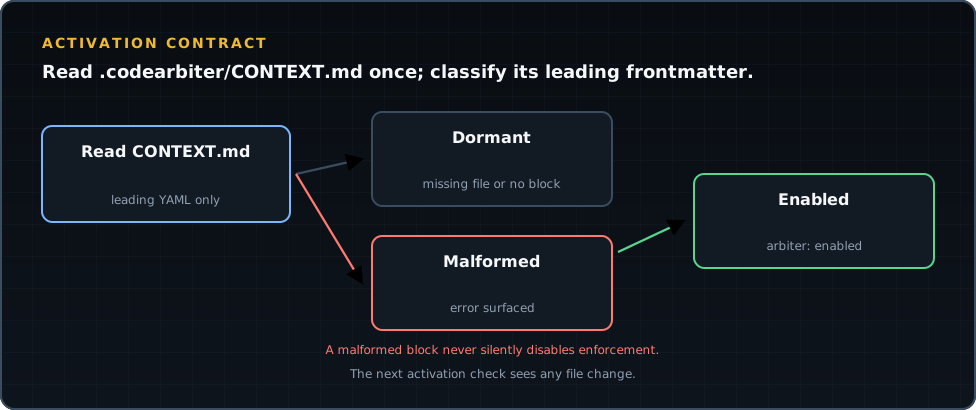
Writers: /ca:init (scaffold), /ca:decompose and /ca:create-context (populate + lock).
Readers: every enforcement hook, the SessionStart injector, the statusline.
Editable by hand? The prose body, yes. The frontmatter is guarded: a Write/Edit that would
flip arbiter: enabled off, or corrupt the block, is blocked (pre-write.py/pre-edit.py,
issue #159). The file that turns every gate off can’t itself be edited past the gate.
Delete it: codeArbiter goes fully dormant in this repo on the next session (no persona, no
enforcement, nothing loads). The rest of .codearbiter/ is untouched on disk; recreating
CONTEXT.md (or running /ca:init again) reactivates it against whatever state remains.
code-map.md
Section titled “code-map.md”A source-backed orientation map from repository concerns to paths and roles. Context creation or decomposition writes it after inspecting the codebase; feature and planning lanes read it when present so task discovery begins from known seams instead of a whole-tree search.
The map is not an access-control list. Its claims carry provenance and can become stale when source
paths move. /ca:context-check reports that drift and offers re-scout, re-baseline, or defer.
Writers: /ca:create-context, /ca:decompose, and provenance auto-heal.
Readers: feature/task planning and context-check flows.
Editable by hand? Yes, but source claims should be re-proven.
Delete it: governed lanes fall back to repository discovery; enforcement remains active.
open-tasks.md
Section titled “open-tasks.md”The board: one top-level - bullet per task, in one of three states:
queued (- [ ]), in-progress (- [~], always carrying a started date), or done (- [x]). The
only sanctioned writer is /ca:task (add / start / done), which calls the pure
_taskboardlib transforms via taskwrite.py so every entry stays schema-conformant and every
transition dated. Hand-editing risked malforming the schema, which is why the command exists.
A task’s [x] done-flip, [~] start-flip, or new [ ] entry rides the work commit itself
through commit-gate (ADR-0008); there’s no separate lagging board-only PR.
Writers: /ca:task only. Readers: /ca:status, the statusline, SessionStart (in-flight
count and staleness). Editable by hand? No: guarded to the one writer, and that guard is now
enforced rather than advisory. The file is enrolled in the protected-state registry as
helper-only (hook H-22), so a hand-rolled Write, Edit, shell redirect, write verb, or
interpreter one-liner naming it is refused across all three flanks. Reading it is untouched.
Delete it: the board is empty going forward; nothing else breaks, but every count that reads
it (statusline, /ca:status) reports zero until tasks are re-added.
done-tasks.md
Section titled “done-tasks.md”The permanent record of archived work. /ca:task archive (and /ca:standup’s per-item archival
sweep) moves a long-done task here so the board keeps reporting current work rather than history.
An in-flight count that includes tasks finished three months ago stops meaning anything.
Enrolled in the protected-state registry as append-only (hook H-22): a completed task has
exactly one permanent record, so the file grows and is never rewritten in place. The archive verb
writes here before removing from open-tasks.md, so an interrupted sweep leaves a duplicate the
next run absorbs rather than a lost record, and it refuses outright if this file exists but cannot
be read, because rewriting an unreadable archive would discard everything already in it.
Created on first archive; an existing repository won’t have one until then.
Writers: /ca:task archive only. Readers: on demand; nothing computes a count from it.
Editable by hand? No: guarded, append-only.
Delete it: the archived history is gone and unrecoverable except through git. Nothing
operational breaks, since the next archive recreates it, but the record it existed to make
permanent is lost, which is the one outcome its policy is designed to prevent.
open-questions.md
Section titled “open-questions.md”The record of unresolved [CONFIRM-NN] items: numbered placeholders for a question only the
user can answer, per the terminology lock in arbiter.md §0.1. An open CONFIRM-NN blocks
the dependent work until it is resolved; it is never guessed at or resolved inside an ADR. The
SessionStart hook and the statusline both count occurrences here.
Writers: the orchestrator, when a skill surfaces a genuine unknown. Readers: /ca:status,
SessionStart, the statusline. Editable by hand? Yes: resolving a CONFIRM-NN is a prose
edit recording the decision and its date. Delete it: any [CONFIRM-NN] count in the
statusline or /ca:status reads zero; a future skill that needs to raise one recreates the file.
decisions/
Section titled “decisions/”One numbered, dated, user-attributed file per Architecture Decision Record (0001-*.md,
0002-*.md, …), plus decision-log.md, an append-only ledger that mirrors every ADR as one
entry. /ca:adr is the only sanctioned author; both the shell flank (redirects, cp, sed -i
targeting decisions/) and the Write/Edit flank are guarded (H-11) so an ADR can’t be
fabricated, edited after the fact, or slipped in outside the command. Status moves through
proposed -> accepted -> superseded | rejected; a superseding decision never rewrites the prior
file. It appends a new numbered ADR whose own text names what it supersedes, and a new
decision-log.md entry does the same.
Writers: /ca:adr (via the decision-lifecycle skill) only. Readers: /ca:adr-status,
/ca:reconcile, and post-write-edit.py’s H-12 advisory (a file matching an ADR’s governs:
glob gets a reminder on every future touch). Editable by hand? No: guarded.
Delete it: the project’s decision history is gone; governs: reminders for any ADR that used
to cover a file stop firing, and /ca:adr-status has nothing to report.
specs/
Section titled “specs/”One markdown file per feature/campaign spec, written by the brainstorming skill once a spec is
approved (/ca:feature, /ca:sprint). writing-plans reads an approved spec to derive its task
plan, and /ca:status lists every slug here alongside its plan to show how far each pipeline got.
Writers: brainstorming. Readers: writing-plans, /ca:status.
Editable by hand? Yes. Specs are prose documents; edit for clarity, but avoid rewriting
acceptance criteria the plan and its tests already trace against.
Delete it: /ca:status no longer lists that pipeline; a plan that referenced the missing spec
still runs (the plan is self-contained), but nothing can re-derive it from the (now-gone) spec.
plans/
Section titled “plans/”One markdown file per feature’s task plan, written by writing-plans from an approved spec.
Each task carries an exact file path and a verification step that maps to a tdd obligation.
executing-plans and subagent-driven-development consume it task by task; /ca:status reports
the ACCEPTED-vs-total count for an in-progress plan.
Writers: writing-plans. Readers: executing-plans, subagent-driven-development,
/ca:status. Editable by hand? Yes, though editing mid-execution risks desyncing the
plan from tasks already marked accepted. Delete it: an in-progress feature loses its
resumption point; /ca:status can no longer report that pipeline’s progress.
.decompose-draft/
Section titled “.decompose-draft/”Temporary, resumable state for a greenfield decomposition interview. Each completed layer is persisted here before the final project documents are assembled, so a closed session can continue without repeating accepted answers.
The directory is working state, not a second project context. A successful decomposition consumes the draft into the normal scaffold and removes the temporary directory.
Writers/readers: /ca:decompose only.
Editable by hand? No useful reason; resume through the command.
Delete it: an unfinished interview loses its saved progress and must restart. A completed
scaffold is unaffected because the directory should already be gone.
checkpoints/
Section titled “checkpoints/”One dated report per /ca:checkpoint sweep (YYYY-MM-DD.md), written by the
checkpoint-aggregator agent from the finding-triage and decision-challenger output. Findings are
classified by severity; the ones blocking the current change are called out, the rest recorded
for later. /ca:tribunal’s deep-audit output is a distinct artifact (reports/<run-id>/, below).
Checkpoints are the lean, routine sweep.
Writers: checkpoint-aggregator. Readers: humans (the report is the deliverable);
/ca:audit pulls still-open findings from the most recent one. Editable by hand? Yes, though
there’s rarely reason to. Delete it: history of past sweeps is gone; the next /ca:checkpoint
recreates the directory and writes fresh.
audits/
Section titled “audits/”One dated governance packet per /ca:audit run (YYYY-MM-DD.md), assembling commits, overrides,
ADRs, sprint auto-decisions, open questions, and open checkpoint findings for a given range into
one document. /ca:audit is read-only against everything it summarizes: it never mutates
overrides.log, decisions/, or any of its other sources.
Writers: /ca:audit. Readers: humans. Editable by hand? Yes.
Delete it: past audit packets are gone; nothing else in the framework depends on their
presence, since /ca:audit re-derives everything from the underlying logs and files each run.
reports/
Section titled “reports/”Durable evidence and handoff material owned by a named workflow. Tribunal uses
.codearbiter/reports/<run-id>/, where <run-id> is <UTC-date>-<scope-slug>. A fresh run opens
run.jsonl; a resumed run reuses the same ID. Findings are written one file at a time with
append-only triage/run logs so an interruption resumes from disk.
Other governed campaigns may write a clearly named report or handoff directory here. The owning spec or plan defines its schema; the directory is not an unstructured dumping ground.
Writers: the owning governed workflow. Readers: that workflow on resume and humans reviewing its evidence. Editable by hand? Not while an owning run is active. Delete it: an in-flight workflow may lose its resumption record; completed evidence disappears. Filed GitHub issues, if any, are unaffected.
sprint-log.md
Section titled “sprint-log.md”The append-only ledger of every SMARTS-scored auto-decision an autonomous /ca:sprint makes on a
non-hard-gate point, each entry carrying a confidence flag (low entries are the ones worth
reviewing after the fact). Hard gates (security controls, auth/crypto/secrets, irreversible
operations, an unresolved [CONFIRM-NN], a merge to default) are never auto-decided and never
appear here as a resolved decision; they stop and surface to the user instead.
Writers: /ca:sprint. Readers: /ca:status, /ca:audit, the staleness-warn check (a
sprint marked active for over 30 minutes with no matching log activity gets a WARN).
Editable by hand? No. One of the four append-only audit logs (H-05): a shell truncation/
rewrite aimed at it is blocked, and a Write/Edit must be a verifiable tail-anchored append, never
an overwrite or an empty-old_string edit passed off as one.
Delete it: the sprint decision trail for past runs is gone; a /ca:sprint in progress that
depended on it for staleness-warn context loses that signal, though the sprint itself can still
recreate the file on its next append.
overrides.log
Section titled “overrides.log”The append-only, permanent audit trail of every /ca:override bypass and every mode-plane
transition (mode --dangerous/--ops, a deterministic whole-prompt token flip, never a command).
Two row formats share this file. Do not read one as the other.
| Override row | Mode-transition row | |
|---|---|---|
| Format | [ISO-8601] | BY: <name> <<email>> | GATE: <gate bypassed> | REASON: <reason> | [ISO-8601] | BY: session-mode | HOST: <host> | SESSION: <id> | MODE: <name> enter|exit | NOTE: — |
| Identity | the operator, from git config user.email; if unset the user is asked once rather than recording an empty BY: | the literal session-mode, because a mode flip is a posture change by the session and not an act attributed to a person |
| Fields | GATE and REASON | HOST, SESSION and MODE; no GATE, no REASON |
The SESSION field is load-bearing, not decoration: an enter row is what
authorizes a gates-off marker to take effect, so it is matched per session.
Without it one session’s row would authorize another session’s marker. Rows
written before the field existed authorize no session and resolve to arbiter.
A MODE: row is therefore not a user-attributed override, and counting the two together
overstates how often a human bypassed a gate. Readers accept legacy DEV: rows too, since existing
history is append-only and never rewritten. The statusline counts entries newer than the
last-checkpoint marker as “overrides since last checkpoint.”
Writers: /ca:override, the mode-plane flip (prompt-submit.py, MODE: entry/exit lines).
Readers: statusline, /ca:status,
/ca:audit, the CONFIRM-09 staleness-warn check. Editable by hand? No. H-05 guarded, same as
sprint-log.md: append-only, tail-anchored edits only, no truncation or rewrite.
Delete it: the entire override history is gone (a genuine loss, since this is the one
mechanical record that a bypass happened at all). codeArbiter keeps functioning; the audit trail
does not recover.
triage.log
Section titled “triage.log”The append-only record of every small-lane classification /ca:feature makes (the SMARTS
reasoning behind routing a change to the lighter lane instead of the full spec-to-plan pipeline).
/ca:metrics reads it to compute the small-lane rate trend.
Writers: /ca:feature (small-lane triage step). Readers: /ca:metrics, /ca:audit.
Editable by hand? No: H-05 guarded, same append-only contract as the other three logs.
Delete it: the small-lane classification history is gone; /ca:metrics’ small-lane-rate trend
has nothing to compare against until new entries accumulate.
gate-events.log
Section titled “gate-events.log”Every block(), remind(), and warn() call in the hooks appends one line to this durable,
mechanical sink. Format: [ISO-8601Z] KIND [tag] host=<host> hook=<script> | msg. Before this log
existed, a gate decision was visible only in the ephemeral per-turn stderr transcript; this makes
every BLOCK, REMIND, and WARN durable and queryable after the fact. The write is fail-open by contract: a
missing .codearbiter/ directory or an unwritable log file is swallowed silently rather than
changing the calling hook’s exit code. This sink must never itself cause a gate to misbehave.
Writers: every hook, via the shared _log_gate_event() helper in _hooklib.py.
Readers: none ship yet as of this writing. It’s a durable record for manual inspection or a
future consumer. Editable by hand? No: H-05 guarded, same append-only contract.
Delete it: past gate decisions are gone from the durable record; hooks keep blocking/reminding
exactly as before (the log is a side effect of a gate decision, never a precondition for one), and
a fresh file is created on the next event.
.markers/
Section titled “.markers/”Gate-pass tokens and short-lived UI flags, created on demand. This directory doesn’t exist until the first marker-writing action runs. The load-bearing ones:
security-gate-passed— written bysecurity-pass.pyon a genuine crypto-compliance or secret-handling PASS. It contains a SHA-256 digest of every sensitive added line it approved, not just an empty touch. The commit-time gates (H-09b for crypto/TLS, H-10b for secrets) block a commit unless this marker is fresh (written within the last 30 minutes) and covers every sensitive line in the current staged diff. A pass recorded for one diff can’t launder a later, different change through the freshness window.migration-gate-passed— the same digest-binding contract, for the H-14 migration-review gate, written bymigration-pass.pyagainst a migration file’s current content.mode— a gitignored file holding the session’s current posture (arbiter,dangerous, orops), session-keyed, written by the deterministicmode --dangerous/--ops/--arbitertoken flip and cleared atSessionStart. Absent, empty, unreadable, or unrecognized resolves toarbiter. Drives the statusline’s red-shift indangerous; not itself gate-bearing. No enforcement hook reads it, only the persona composed at each turn does.adr-authoring-active— touched by/ca:adrwhile an ADR authoring session is open; the one marker a command other than the security-pass helpers legitimately writes directly.
Writers: security-pass.py, migration-pass.py, prompt-submit.py (mode marker), /ca:adr.
Readers: the commit-gate hooks (pre-bash.py) that check security-gate-passed and
migration-gate-passed before allowing a git commit.
Editable by hand? No: pre-write.py/pre-edit.py block Write/Edit targeting this directory
(issue #160), and pre-bash.py’s H-19 flank blocks the shell forge spellings too (cp/mv/tee/
sed/a redirect, and an interpreter one-liner such as python -c "open(...).write(...)"). These
flanks add real friction and leave an audit trail on the cooperative-agent path (ADR-0010). They
are not a proof. The marker is a cooperative attestation: security-pass.py/migration-pass.py
re-derive digests from a public, pure function of the file content the forger already holds, so no
digest scheme can make the marker unforgeable to a determined same-user process willing to
reproduce that computation outside the sanctioned producer. Its value is the friction and the
record it leaves, not unforgeability.
Delete it: every commit-time crypto/secret/migration gate reverts to its unpassed state. The
next sensitive commit blocks until the corresponding gate runs again and re-records a pass. No
enforcement is weakened; you just lose the standing “already checked” credit.
.provenance/
Section titled “.provenance/”Per-doc JSON evidence files (<doc>.json for tech-stack, coding-standards,
security-controls, CONTEXT, and similar derived docs), created the first time
context-creation or decompose populates .codearbiter/. Each record lists the source paths
that backed the doc’s claims, a content hash per path (via git hash-object, so a line-ending
normalization never false-flags as drift), and the specific claim each source line supports.
SessionStart diffs the recorded hashes against the current ones and surfaces a one-line drift
count when a tracked source has moved since the doc was last baselined; commit-gate can auto-heal
the affected doc from there.
Writers: context-creation, decompose, and context-check’s re-scout/re-baseline actions.
Readers: SessionStart (the drift line), commit-gate (auto-heal worklist).
Editable by hand? Not usefully: a hand-edited hash wouldn’t match anything real. Regenerate
it through /ca:context-check instead. Delete it: drift detection goes silent for every doc
that lost its record (no false positives, but no warning either), until the doc is re-scouted or
re-baselined and a fresh provenance file is written.
Other scaffold docs
Section titled “Other scaffold docs”/ca:init creates the activation file, open boards, override log, and checkpoint counter. It then
routes an existing codebase to /ca:create-context or a greenfield repository to /ca:decompose.
Those context-building flows produce security-controls.md, tech-stack.md, and
coding-standards.md. They are living reference documents, not audit logs: hand-editable, read by every
reviewer agent (security-controls.md especially: the crypto-compliance and secret-handling gates
read it before every review, and it’s level 1 in the conflict hierarchy). last-checkpoint is a
one-line counter (the override count at the time of the last /ca:checkpoint) that the statusline
and /ca:status use to compute “overrides since last checkpoint.” It’s a counter, not a note, so
there’s rarely reason to hand-edit it. spikes/ holds one findings file per /ca:spike (the
question asked, what was tried, the answer, and what it implies), written on exit, since spike code
itself is disposable and never merges.