
What Is the Feature Forge
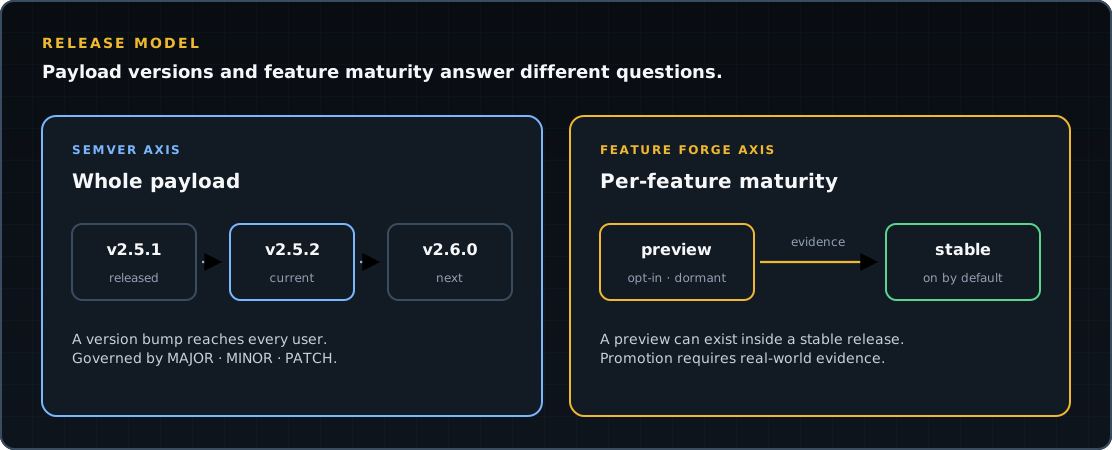
SemVer answers one question: did the plugin payload change? A version bump means every user gets the new payload. It says nothing about whether a given feature inside that payload is ready to trust by default.
The Feature Forge answers the second question, per feature. A feature can ship in preview: opt-in, dormant, off by default. It rides along in a release without changing anyone’s behavior until they turn it on. Once real-world evidence shows it holds up, it gets promoted to stable and becomes on by default. The version says the whole payload moved; the forge says which individual features have earned trust.
That is the two-axis model. Read them together and a release is legible: SemVer governs the whole payload, the Feature Forge governs each feature’s maturity.
Promotion is driven by evidence, not by a calendar. A preview feature graduates when its real-world use shows it is safe to default on, and that judgment is recorded as a tracked decision rather than assumed. The forge keeps the cost of trying something new low and the cost of trusting it honest.
What preview means for you
Section titled “What preview means for you”A preview feature must stay dormant until you opt in. Before enabling one, read its live entry,
identify the environment variable or command that arms it, and note how to turn it off. Start with
the least consequential mode when one exists, such as transcript pruning’s dry mode. A preview
label is not permission to weaken a hard gate or to accept undocumented spending.
If behavior changes while its opt-in is absent, treat that as a defect. Disable the feature, record the observed version and host, and follow Troubleshooting.
After enabling a preview, verify the inverse as well: remove its flag or environment variable, start a fresh session when startup state is involved, and prove the feature is dormant again. A preview whose off switch cannot be demonstrated is not safe to evaluate in consequential work.
Related
Section titled “Related”- What’s in the Forge: the live list of features currently in preview.
- Using features still in the Forge: how to turn a preview feature on.