
Enforcement & Security
codeArbiter’s gates are not advice the model can talk past. They run at each host’s tool-call
boundary with no third-party Python dependencies. All three governance adapters consume the same
guard core. Claude Code receives its exit-2 verdict directly; Codex’s pre-tool-adapter.py
converts the same verdict to a structured deny response so Windows shell exit handling cannot
weaken the block; Pi’s trusted wrapper carries the shared verdict through its bridge. See the
Claude Code + Codex evidence.
For the per-hook breakdown, see the Hooks reference.
Diagnose a Block End to End
Section titled “Diagnose a Block End to End”Start with the complete message. Do not begin by guessing which command or reviewer owns it:
BLOCKED [H-03]: stage explicit file paths; broad staging is not allowedUse this five-step trace:
- Keep the gate id and exact action.
H-03identifies the rule; the denied Git command identifies the boundary where it ran. - Name the host flank. Claude Code receives the Python hook’s exit-2 block, Codex receives the adapter’s structured deny result, and Pi receives the wrapper verdict. The policy is shared even though the delivery surface differs.
- Open the generated Hook Gates reference. Find
H-03to see the emitting source line, event, matcher, and current message from the shipped payload. - Choose the sanctioned remediation. For H-03, inspect the worktree and stage explicit file paths. A security or migration gate instead routes through its owning review. An override is relevant only when the gate permits it and the exception is genuinely justified.
- Prove the next boundary. Re-run the intended narrow action. If the block is missing,
inconsistent across hosts, or appears before repository activation, run
doctorand diagnose registration before changing policy.
The successful outcome is not merely “the command ran.” It is that you can connect one visible verdict to its gate id, host registration, source call site, remediation, and durable audit effect.
The Activation Contract
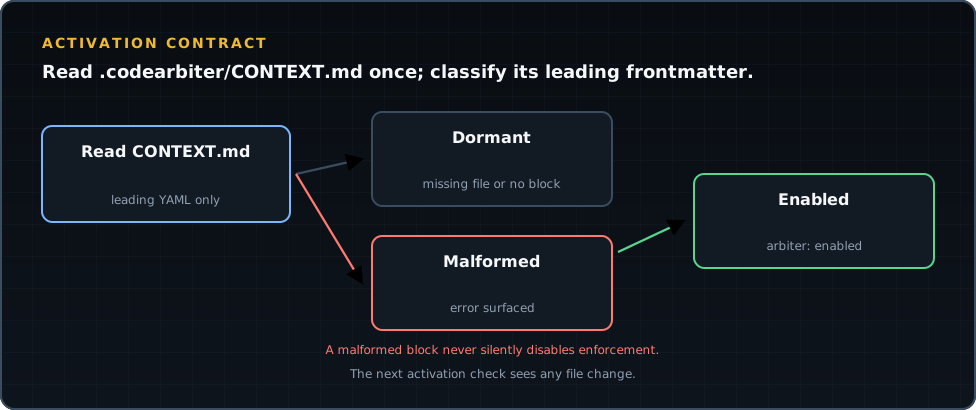
Section titled “The Activation Contract”codeArbiter is dormant until a repository opts in. Every enforcement hook calls arbiter_active(), which is true only when .codearbiter/CONTEXT.md carries arbiter: enabled in a properly closed leading YAML frontmatter block. A repo with no such file, or no such line, loads nothing and blocks nothing.
- Opt-in by file, not by install. Installing the plugin does not enforce anything. Enforcement begins the moment
CONTEXT.mddeclares the repo enabled. - Persona injection. On an enabled repo, the
SessionStarthook injects the orchestrator persona. That single file is the only always-loaded context. - Malformed frontmatter fails loud. A frontmatter block that opens (
---on line 1) but never closes is surfaced as a malformed-state error, not silently treated as disabled. A file with no frontmatter at all is simply dormant.
Blocking Commit-Time Gates
Section titled “Blocking Commit-Time Gates”These originate in the shared Python guard core and reach each host through its registered hooks,
adapter, or wrappers. Each blocks the tool call outright. Ambiguity resolves closed: a spelling
that cannot be told apart from a destructive one is blocked. /ca:override is the sanctioned
escape hatch only for gates that permit bypass; H-18 deliberately does not.
| Gate | Enforces |
|---|---|
| H-01 | No direct commit or push to the default branch. Covers main/master case-insensitively, a detached HEAD sitting on a protected branch’s tip (the commit still lands on that history), and protected refspecs (HEAD:main, feature:main, :main deletion, refs/heads/main), plus --all/--mirror bulk pushes that publish every ref. |
| H-02 | No force-push, in any spelling: --force, --force-with-lease, --force-if-includes, bare -f, or a forcing +refspec. |
| H-03 | No wildcard staging. Blocks the flag forms (-A, --all, -u, .) and the argument forms (globs, directories, pathspec magic). Staging must name files. |
| H-05 | Append-only audit logs (overrides.log, triage.log, sprint-log.md). Shell truncation/rewrite verbs aimed at a log are blocked; the Write/Edit flank blocks overwrites, an empty-old_string Edit (not a verifiable append), and MultiEdit on a log. |
| H-09b / H-10b | Crypto and secret commit gate. A commit that introduces a crypto/TLS or secret line is blocked unless the crypto-compliance / secret-handling gate has recorded a pass for those exact lines. |
| H-11 | ADRs are authored only via /ca:adr. Both the shell flank (redirects, cp, rm, sed -i into decisions/) and the Write/Edit flank are guarded; the skill drops a fresh authoring marker first. |
| H-14 | Migration review. A commit staging a database migration is blocked unless a migration-review pass is recorded for that file’s current content. |
| H-18 / H-19 | Repository activation cannot be disabled through governed shell, Write, Edit, or patch operations. Common gate-pass marker forge paths are blocked as cooperative attestation; a determined same-user process remains outside that guarantee. |
| H-20 | --no-verify and its supported short forms cannot bypass the repository’s pre-commit or pre-push backstop. |
| H-21 | A write or edit envelope the host adapter cannot decompose into guardable per-file operations is refused instead of being allowed through uninspected. Retry as a plain supported patch or split the operation. |
H-09b/H-10b is digest-bound: a recorded pass covers only the exact sensitive lines it approved, which closes a time-of-check / time-of-use gap between approval and commit. The board-sync behavior implied by the commit gate (only /ca:task writes open-tasks.md) follows from ADR-0008. For the design rationale behind both, see Selected Hardening Notes.
Advisory, Non-Blocking Reminders
Section titled “Advisory, Non-Blocking Reminders”post-write-edit.py (PostToolUse(Write|Edit)) surfaces reminders right after a write. These never block. They nudge so the blocking gate is not a surprise at commit time.
- H-09 / H-10: crypto/TLS or secret pattern touched. Run the gate now; the commit will block until a pass is recorded.
- H-12: the file is governed by an accepted ADR (
governs:glob). Route to/ca:reconcileor/ca:adrrather than drift. - H-15: CI/CD workflow changed. Dispatch
security-reviewerbefore the PR merges. - H-16: deployment / IaC manifest changed. Same.
- H-17: authentication/authorization logic touched (narrow, high-signal patterns only).
- Plus H-07 (dependency manifest changed) and an anti-slop prose check on user-facing docs.
These are advisory because they bite at a later boundary, not at commit. A bad CI workflow, IaC manifest, or auth change does damage only once merged or applied, and security-reviewer is the real enforcement point at the PR. The dangerous crypto and secret primitives, which land the moment code ships, stay hard-blocked by H-09b/H-10b.
Sandbox Isolation for Untrusted Repositories
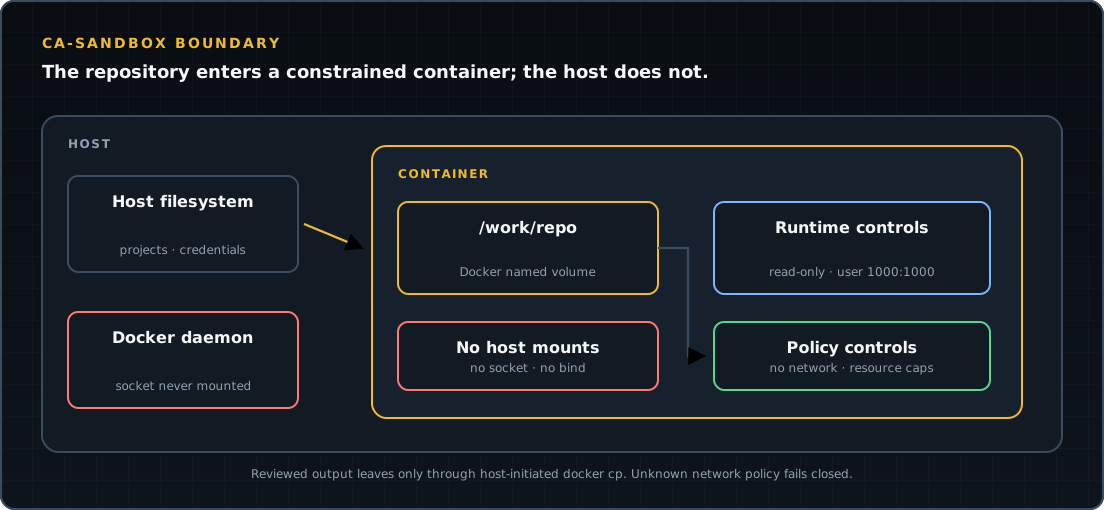
Section titled “Sandbox Isolation for Untrusted Repositories”codeArbiter runs untrusted repositories inside ca-sandbox, isolated as non-root (--user 1000:1000), with a --read-only root, --cap-drop ALL, --security-opt no-new-privileges, and a fail-closed network policy (default --network none; an unknown policy is a hard error, not a silent pass-through). No host bind mounts; the docker socket is never mounted. For selected rationale behind this posture, see Selected Hardening Notes.
Pi: Project Trust and Child Processes
Section titled “Pi: Project Trust and Child Processes”The complete ca-pi adapter currently ships as a Feature Forge preview.
Real use and feedback are welcome while broader testing continues before
stable status or a claim of 100% validation.
Pi’s activation contract is the same arbiter: enabled flag as Claude Code and Codex, plus one
addition: an enabled repository still requires Pi’s own affirmative project-trust decision before
repository-aware startup. The parent registers repository-aware dispatch, farm preview, and native
compaction only after the current session reports that trust, the repository is enabled, and the
enforcement lifecycle is ready. A session opened before trust is granted, or before the repo opted
in, stays inert: nothing repository-aware runs.
codearbiter_dispatch and codearbiter_farm_preview are parent-only EXEC tools. A child
process spawned to do author or reviewer work cannot escalate itself into repository-aware dispatch
or farm access. Ordinary child/subagent environments never receive FARM_API_KEY or other
governance secrets; that key is scoped to the trusted parent only.
Run /ca-doctor to verify this is actually live: it inspects the active package path, command
ownership, Python/core/bridge health, child fingerprint, and the H-03 wrapper self-test. Its
module-identity check proves self-consistency between the operator-launched Pi CLI, imported module,
package root, and reported version. It does not prove publisher authenticity. Verify the
installed source separately with pi list and pi config.
Fail-Loud, Never Silently Dormant
Section titled “Fail-Loud, Never Silently Dormant”The hooks fail loud: a blocking gate prints BLOCKED [H-NN]: … to stderr and exits 2. The one deliberate fail-open is hook-input parsing. A malformed stdin must not brick the session by blocking every subsequent tool call (documented in _hooklib.read_input()).
Enforcement is resilient to host interpreter conventions. Claude Code carries its tested
interpreter fallback. Codex registers one OS-specific command per event (python3 on POSIX,
python on Windows), avoiding concurrent handlers with conflicting results.