
What Is codeArbiter
codeArbiter is one governance product with three host adapters: ca for Claude Code, ca-codex
for Codex, and ca-pi for Pi. The Claude Code marketplace also carries ca-sandbox, an
infrastructure plugin unrelated to gate enforcement (see ca-sandbox); the
Codex marketplace carries ca-codex, while Pi uses npm with pinned Git tags as the reproducible
channel. All three governance adapters inject the same orchestrator responsibilities, enforce the
same policy core, and use one checked-in .codearbiter/ directory for project context and audit
state. See the
Claude Code + Codex evidence for the verified boundary
between those two, and Pi for the third host’s install and trust model.
The complete ca-pi adapter is currently a Feature Forge preview: real use
and feedback are welcome while broader testing continues before stable status.
codeArbiter Holds the Gates; You Hold the Decisions
Section titled “codeArbiter Holds the Gates; You Hold the Decisions”This is the organizing principle. codeArbiter enforces process; you make the calls. It holds the gates: the test-first rule, the review chain, the secret and crypto checks, the commit and merge boundaries. Work does not pass a gate without clearing it. But the decisions those gates surface belong to you. Which design? Which trade-off? Whether to merge? Those are yours to make. When a gate finds something worth your attention, it reports the finding plainly and waits for your call. It does not resolve the question on your behalf.
How a Request Flows
Section titled “How a Request Flows”- Command. Invoke
/ca:featurein Claude Code or$ca-featurein Codex. The generated command surface differs in spelling, not ownership or policy. - Route. The orchestrator hands the command to the workflow that owns that lane.
/ca:fixand$ca-fixboth reach the same test-first obligations. - Execute the roles. The owning skill selects the author and reviewer roles the change actually demands. Claude Code dispatches plugin agents. Published releases from 0.7.5 include the complete packaged resource charter set for that release for Codex host-provided agent threads, with exact static-package and route-closure checks at release. A bounded 0.9.4 receipt proves one exact installed-charter review. Adapters may use the bounded inline fallback only where the canonical workflow explicitly permits it and isolation is not mandatory. Pi launches hardened child processes through its trusted parent. The policy stays shared even though each host’s mechanism differs.
- Gate. Nothing advances until its gates are green. A failing test, a CRITICAL security finding, an unresolved decision: each is a real stop.
- Ship. Code reaches version control only through the commit gate, and the default branch only through a pull request. Never a direct write.
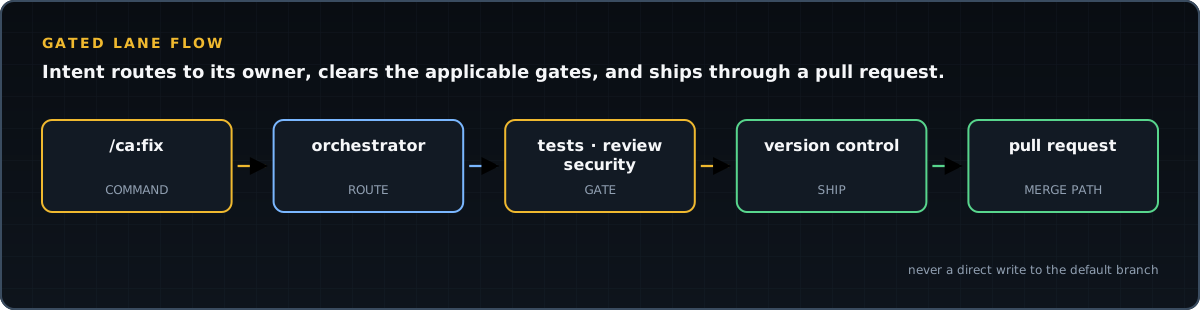
Gate
A gate is not advice you can wave off. It is the only path that kind of change takes to ship. When a gate trips, codeArbiter surfaces the decision and waits for you to resolve it.Context Minimization
Section titled “Context Minimization”codeArbiter is built so almost nothing loads until it is needed. The only always-loaded
context is one file, the orchestrator persona, injected by a SessionStart hook, and only
in repositories whose project state opts in. A repo that hasn’t opted in loads nothing at
all.
Everything else is paid for on demand: the routing table, the reference map, every skill
body, every agent body, the design-quality reference bundle. A node loads only when an
entry point reaches it. A typical /ca:fix touches the persona, the test-first skill, one
author, and maybe one reviewer. It never pulls the whole payload. Read-only meta commands
like /ca:status, /ca:btw, and /ca:commands route to no skill at all.
The Lanes
Section titled “The Lanes”Work is organized into lanes. Each is a sanctioned path with gates scaled to its risk.
- Implementation:
/ca:feature(checkpointed),/ca:sprint(autonomous, every auto-decision SMARTS-scored),/ca:fix,/ca:refactor,/ca:debug,/ca:chore,/ca:spike. - Commit & ship:
/ca:commit,/ca:pr,/ca:watch,/ca:checkpoint,/ca:tribunal,/ca:release,/ca:add-dep./ca:checkpointis the lean periodic sweep;/ca:tribunalis its rare, deep counterpart: an on-demand, resumable whole-codebase audit by eleven specialist lenses that files findings as GitHub issues on your approval and is never a required gate. - Decisions:
/ca:adr,/ca:adr-status,/ca:reconcile,/ca:conflict,/ca:threat-model. - Project & meta:
/ca:init,/ca:status,/ca:audit,/ca:doctor,/ca:btw, and more.
See Concepts for the ideas behind the lanes, and the Reference for the full, auto-generated catalog of commands, skills, and agents.