
The Gated-Lane Model
Every kind of work has a lane: a sanctioned path with gates scaled to its risk, and the
only way that kind of change ships. /ca:fix and /ca:feature run test-first through the
tdd gate. /ca:refactor must prove behavioral parity through unmodified pre-existing
tests. /ca:chore carries lighter gates, because prose edits and dependency bumps don’t
demand TDD.
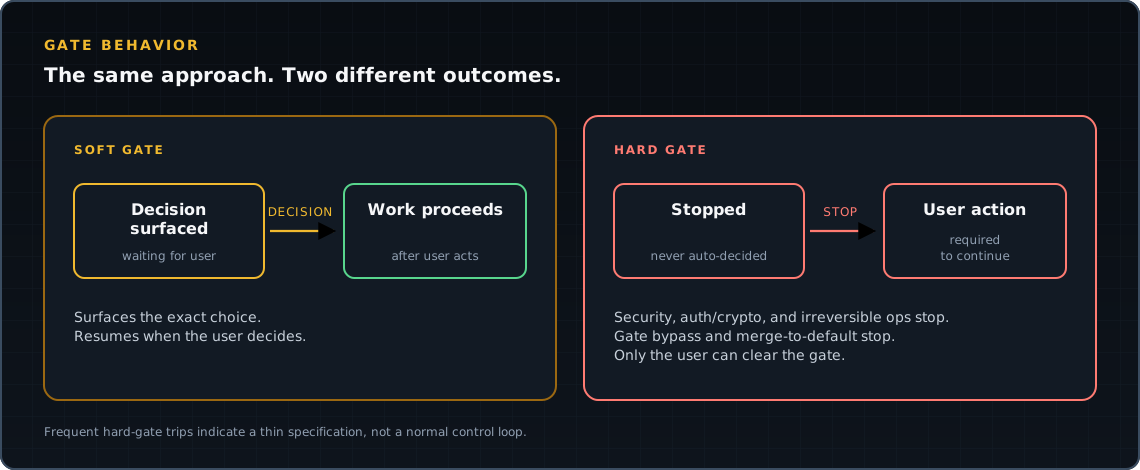
Gates come in two strengths. Soft gates surface a decision and wait for the user. Hard gates are true stops, never auto-decided, even under autonomous execution: anything in the security controls, auth/crypto/secret changes, irreversible operations, a gate bypass, an unresolved decision, or a merge to the default branch. Hard gates are rare by design; a hard gate that trips often is a signal the spec was too thin, and worth fixing at the spec rather than working around at the gate.
Choose a lane from the work, not its size
Section titled “Choose a lane from the work, not its size”| Situation | Start here | Why |
|---|---|---|
| Add user-visible behavior | /ca:feature | A spec and failing test establish the new contract. |
| Repair a defect with a confirmed cause | /ca:fix | A regression test must fail before the minimal repair. |
| Find the cause of an unexplained failure | /ca:debug | Investigation comes before selecting a change lane. |
| Restructure without changing behavior | /ca:refactor | Existing tests must remain unmodified and prove parity. |
| Change docs, bump a dependency, or revert | /ca:chore | The lighter lane scales evidence to non-feature work. |
| Explore a disposable idea | /ca:spike | The branch cannot merge or become a PR. |
| Run a governed multi-task campaign | /ca:sprint | One approved spec and plan drive logged autonomous decisions. |
The number of changed lines does not choose the lane. A one-line behavior change is still a feature or fix; a 500-line generated reference refresh can still be a chore.
How many gates, concretely
Section titled “How many gates, concretely”Lane depth is scaled to risk. The tdd skill runs 6 gated phases:
obligation scan, red, green, obligation verify, coverage, lint. The
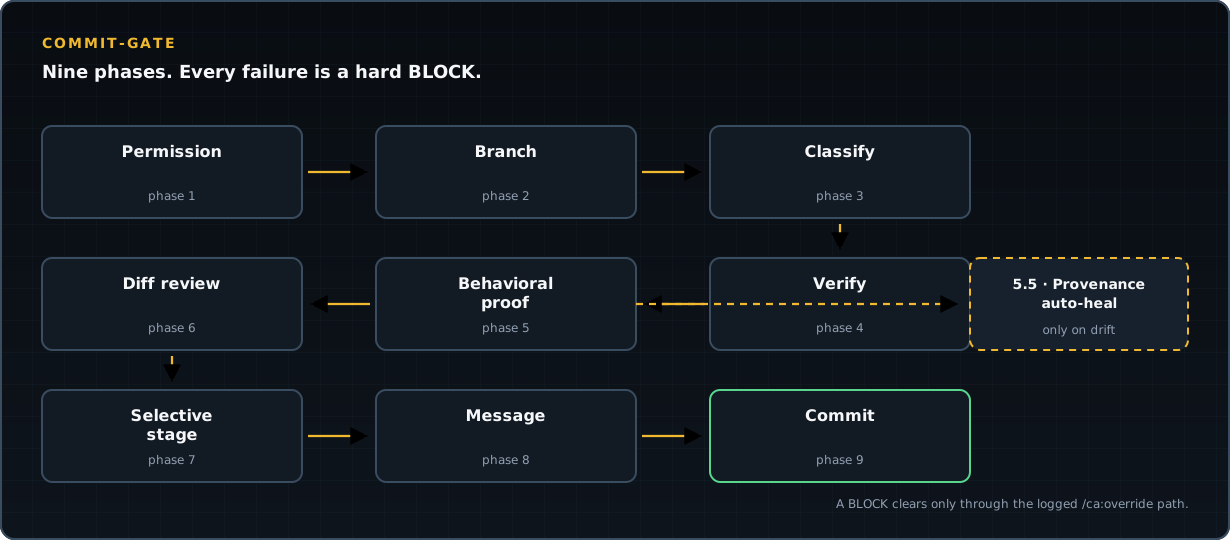
commit-gate skill runs 9: permission, branch,
classification, verification, behavioral proof, diff review, selective stage, message,
commit. It’s the only path to a commit. refactor runs 6
phases, all built around proving behavioral parity through unmodified pre-existing tests.
Mandatory routing at commit time
Section titled “Mandatory routing at commit time”A change that touches certain surfaces pulls a specialist reviewer into the lane automatically, not by request:
- Crypto-compliance and secret-handling changes must mint a digest-bound
security-gate-passedmarker before commit-gate lets the commit through; hooks H-09b and H-10b block it otherwise. - A database migration must mint
migration-gate-passed, enforced by H-14. - A CI or deploy-path change dispatches
security-reviewer, enforced by H-15/H-16, though advisory rather than blocking.
See the hooks and gates reference for the full gate catalog.
The terminal lane
Section titled “The terminal lane”Every change lands through a PR, via finishing-a-development-branch. Direct merge to the default branch is forbidden.
Where a gate permits bypass, the one sanctioned path is
/ca:override: a deliberate, immediate-action exception that
appends one line to overrides.log. It is logged, not silent. H-18 activation protection is the
important exception: it has no in-session override path.
Check your understanding
Section titled “Check your understanding”Take the next item from your issue tracker and write down three things before invoking a command:
- the lane that owns it;
- the first evidence that lane must produce;
- whether the next stop is a soft decision or a hard gate.
Then compare your choice with the command’s generated reference page. A correct classification is the proof for this module; invoking an override because the wrong lane stopped you is not.