
Record an Architecture Decision
Use this guide when a choice will shape later implementation: a storage model, trust boundary,
public contract, dependency policy, or other decision future work must respect. The result is a
numbered record under .codearbiter/decisions/, attributed to the person who made the call and
linked to the paths it governs.
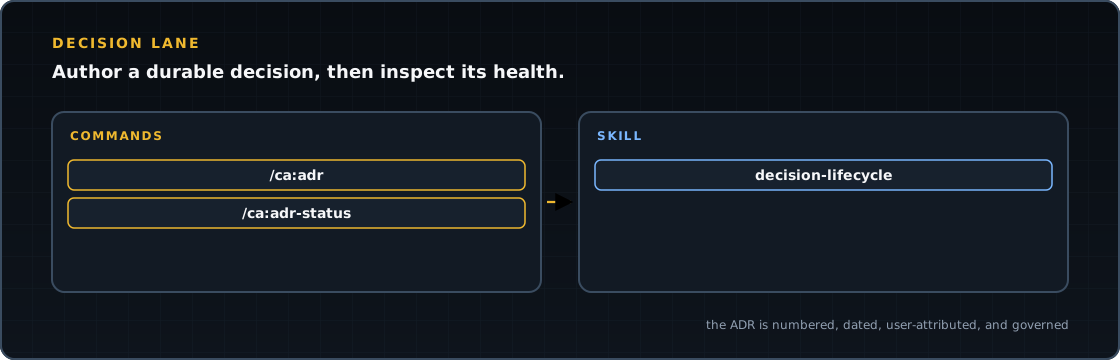
/ca:adr; Codex uses $ca-adr;
Pi uses /ca-adr. Examples below use Claude Code syntax.
Before you start
Section titled “Before you start”- Set
git config user.email. The record and decision ledger use that identity. - Be ready to decide the material trade-off. codeArbiter can structure and challenge the options, but it cannot attribute its own preference to you.
- If the question is still exploratory, use
/ca:btwor a spike first. An ADR records a decision; it is not a scratchpad.
Create a decision
Section titled “Create a decision”Invoke the command with a short title:
/ca:adr "Store durable workflow state in the repository"The decision-lifecycle skill gathers context, the options considered, the decision, consequences,
and the paths the decision governs. Any fact only you can supply becomes a numbered
[CONFIRM-NN]; it is not guessed.
Review the proposed record. On approval, codeArbiter writes:
.codearbiter/decisions/0017-store-durable-workflow-state.mdThe number is gap-free and the slug is derived from the title. The companion
.codearbiter/decisions/decision-log.md receives the corresponding ledger entry.
Verify the result
Section titled “Verify the result”Open the new ADR and confirm:
- the status is
acceptedonly if you explicitly accepted it; decided-bymatches your Git identity;governslists the intended path globs, not the whole repository by accident;- the options and consequences reflect the choice you made; and
- any
[CONFIRM-NN]still present also appears in.codearbiter/open-questions.md.
Run /ca:adr-status --adr 17 (Codex: $ca-adr-status --adr 17) to read the decision’s current
health and any challenge result.
Supersede a decision
Section titled “Supersede a decision”Do not edit history to make an old ADR look current. Create a new ADR and tell the command which accepted decision it replaces:
/ca:adr "Move durable workflow state to a signed event store"The new record receives supersedes: 0017-store-durable-workflow-state, using the prior ADR’s full
filename stem rather than an ambiguous bare number. The earlier file is left byte-for-byte unchanged.
Supersession is a forward-only chain: the newest record names what it replaces, and the decision
ledger records the transition.
Verify the chain with:
/ca:adr-status --adr 17/ca:adr-status --adr 24The first report should identify the newer governing decision; the second should name 0017 as its
predecessor.
Common stops and recovery
Section titled “Common stops and recovery”| Stop | Why it happens | What to do |
|---|---|---|
| Git identity is missing | Decisions require real attribution | Set git config user.email, then invoke the command again |
A [CONFIRM-NN] is unresolved | Only you can supply the missing fact | Answer it, or leave the ADR proposed until you can |
| The number or file already exists | Another decision won the next sequence number | Re-run through /ca:adr; never hand-renumber files |
| A direct edit is blocked | ADR files have a protected authoring lane | Use /ca:adr to create a replacement or superseding record |
Next steps
Section titled “Next steps”- Read ADRs and the Decision Log for the enforcement and JIT-context model.
- Inspect the exact
adrcommand anddecision-lifecycleskill. - Use Auditability to see how decisions appear in a range audit.